
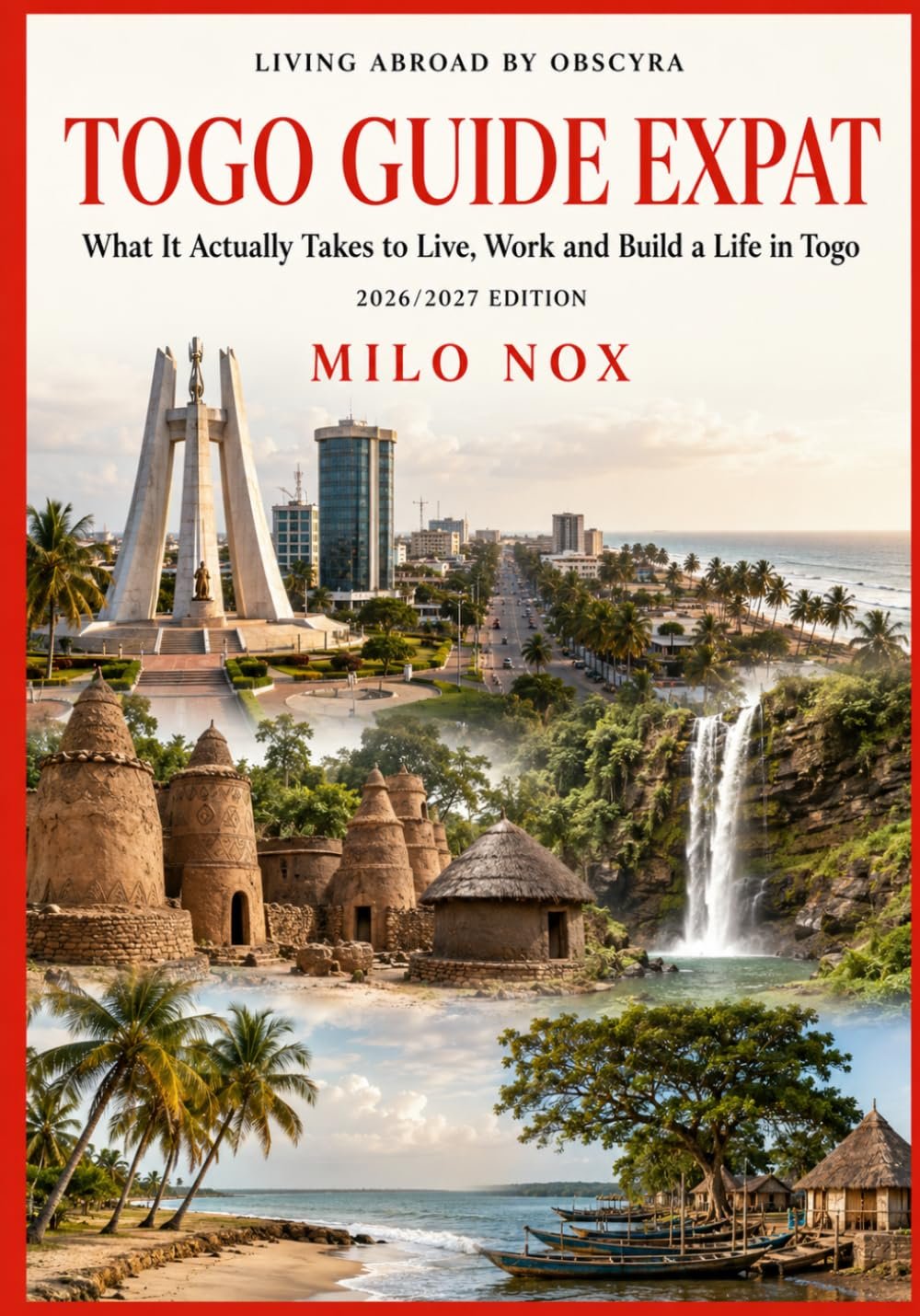
TOGO GUIDE EXPAT
Moving to Togo beyond the clichés: visas, housing, work, healthcare, taxes and everyday life in Lomé, with practical decisions and no false promises.
Avant de partir, comprends le terrain.
Moving to Togo takes more than a visa and a rental agreement. Discover the realities of housing, work, business, healthcare, taxation, security and cultural integration in Lomé and beyond, with a practical guide built for 2026/2027.
Ce que tu vas comprendre
Moving to Togo requires understanding how immigration, employment, housing, finance and public administration fit together. This guide explains the practical differences between entering the country, obtaining residence status and being legally authorised to work. You will learn how to organise documents, identify the correct authorities, prepare applications and avoid confusing an online procedure with a fully completed administrative process.
You will understand the everyday realities of settling in Lomé and other parts of Togo. The book examines rental agreements, deposits, banking, mobile money, electricity, water, internet access, transport and housing inspections. It explains why a seemingly affordable apartment can become expensive when cooling, drainage problems, unreliable utilities, commuting or backup equipment are included in the calculation.
You will discover what different professional profiles need to consider. Employees must understand work authorisation, contracts and local employment conditions. Entrepreneurs need to connect company registration with tax obligations, banking, licensing and immigration status. Remote workers and people earning income abroad must examine whether their activities and tax situation are compatible with their legal status. The guide also covers studying, qualifications and the additional planning required when relocating with children.
Healthcare receives particular attention. You will learn how public and private services differ, why access to specialists is concentrated around Lomé and how insurance, medical evacuation arrangements, essential medication and emergency planning can affect the viability of a long-term move. The book also examines schools, family life, disability, pets and the consequences of living far from specialised services.
Beyond practical arrangements, you will explore Togo’s cultural and social environment. French is the official administrative language, but the country contains many other languages and regional traditions. Greetings, hierarchy, family relationships, religion, indirect communication and local networks all influence daily interactions. Understanding these differences is essential to integration without reducing an entire population to stereotypes.
Finally, the guide addresses the difficulties rarely highlighted in relocation marketing: security concerns, political sensitivity, informal workarounds, regional inequalities, loneliness, cultural exhaustion, unreliable intermediaries and the possibility of returning home. Its purpose is to help you build a relocation plan that remains workable after the initial excitement fades.
Ce que ce guide ne promet pas
This guide does not promise an effortless move to Togo or suggest that a shared language automatically removes cultural and administrative barriers. French is widely used in official procedures, but understanding the language is not the same as understanding the expectations, responsibilities and documentation behind each transaction.
It does not guarantee employment, business success or a low-cost lifestyle. Togo offers opportunities in regional trade, logistics, services and other sectors, but these possibilities depend on qualifications, clients, capital, legal status and the practical conditions of the activity. Economic growth does not automatically translate into a suitable job or profitable business for every newcomer.
The book does not describe Togo as uniformly affordable, safe or well-served. Conditions vary significantly by city, region, income and household needs. Private healthcare, international schooling, reliable electricity, specialised equipment, transport and imported goods can substantially change a monthly budget. Security conditions in the far north must also be assessed separately from ordinary urban risks in Lomé.
It does not guarantee cultural acceptance simply because you make an effort to integrate. Relationships take time, trust cannot be purchased and local customs cannot be reduced to a handful of behavioural tricks. Respect also requires understanding personal boundaries, financial expectations and the difference between a trusted introduction and an officially valid procedure.
This guide provides general information rather than individual legal, tax, medical, immigration or financial advice. Rules and procedures can change, including during the 2026/2027 period. Significant decisions should therefore be checked against current official information and, where appropriate, qualified professional advice.
The aim is not to sell you a dream. It is to help you determine whether living in Togo makes sense for your particular circumstances.
Sommaire détaillé
CONTENTS
CHAPTER 1 – INTRODUCTION (p. 1)
1.1 Why choose Togo? — p. 2
1.2 What to expect in practice — p. 5
1.3 Quick cultural overview — p. 8
1.4 Political environment & freedoms — p. 11
1.5 Social fractures & tensions — p. 14
CHAPTER 2 – PREPARING YOUR DEPARTURE (p. 19)
2.1 Required documents by profile — p. 20
2.2 Visas – Types, conditions, mistakes to avoid — p. 23
2.3 Health insurance – Entry requirements — p. 27
2.4 Translations and equivalency — p. 30
2.5 Departure budget — p. 33
2.6 Pre-departure checklist — p. 37
2.7 Cancelling contracts in your home country — p. 40
2.8 Transport & international relocation — p. 42
CHAPTER 3 – SETTING UP LOCALLY (p. 47)
3.1 Finding housing — p. 48
3.2 Deposit & rental law — p. 51
3.3 Choosing a neighbourhood — p. 56
3.4 Opening a bank account — p. 59
3.5 Tax ID & residence permit — p. 62
3.6 Setting up utilities (water, electricity, internet, etc.) — p. 67
3.7 Furnishing your home — p. 72
3.8 Legal translations & support — p. 73
3.9 Local infrastructure quality — p. 76
3.10 Grey zones & informal workarounds — p. 78
3.11 Buying property & mortgage system — p. 80
3.12 Vehicle import & registration — p. 84
CHAPTER 4 – WORKING IN TOGO (p. 89)
4.1 Employment market overview — p. 90
4.2 Finding a job locally — p. 92
4.3 Salary ranges & cost of life — p. 96
4.4 Freelance & entrepreneurship — p. 99
4.5 Work culture & hierarchy — p. 103
4.6 Discrimination & work rights — p. 106
4.7 Getting paid & tax obligations — p. 110
4.8 Maternity, sick leave & benefits — p. 113
4.9 Remote work & hybrid systems — p. 116
4.10 Recognition of foreign qualifications — p. 119
CHAPTER 5 – STUDYING IN TOGO (p. 123)
5.1 School system — p. 124
5.2 Higher education — p. 128
5.3 Learning the local language — p. 131
5.4 Integrating expat children — p. 133
5.5 Alternatives & homeschooling — p. 136
CHAPTER 6 – HEALTHCARE SYSTEM (p. 139)
6.1 General structure — p. 140
6.2 Registration & entitlements — p. 142
6.3 GPs and specialists — p. 145
6.4 Hospitals and emergency care — p. 147
6.5 Pharmacies & medication — p. 150
6.6 Private or supplementary insurance — p. 152
6.7 Rural healthcare access — p. 155
6.8 Sexual & reproductive health — p. 157
CHAPTER 7 – DAILY LIFE & INTEGRATION (p. 161)
7.1 Daily rhythm & public holidays — p. 162
7.2 Food & shopping — p. 163
7.3 Transport & driving — p. 166
7.4 Social interaction — p. 168
7.5 Breaking the expat bubble — p. 170
7.6 Religion & religious diversity — p. 172
7.7 Local etiquette — p. 173
7.8 Regional lifestyles — p. 176
7.9 Environmental norms — p. 178
7.10 Time, money & authority — p. 179
7.11 Everyday bureaucracy — p. 181
7.12 Everyday discrimination — p. 183
7.13 Disability & difference — p. 185
7.14 Informal survival strategies (« Plan B culture ») — p. 188
CHAPTER 8 – MONEY, TAXES & COST OF LIVING (p. 191)
8.1 Tax residency & treaties — p. 192
8.2 Income tax & VAT — p. 195
8.3 Banking, transfers & payments — p. 197
8.4 Legal optimization — p. 200
8.5 Real cost of living — p. 202
8.6 Inheritance & succession — p. 205
CHAPTER 9 – FAMILY & CHILDREN (p. 209)
9.1 Social benefits — p. 210
9.2 Early childhood & parenting culture — p. 212
9.3 Children’s activities & public spaces — p. 214
9.4 Family law — p. 216
9.5 LGBT+ families — p. 219
9.6 Mixed couples & intercultural relationships — p. 221
9.7 Local adoption — p. 223
CHAPTER 10 – PETS & ANIMAL COMPANIONS (p. 227)
10.1 Entry into the country — p. 228
10.2 Transport — p. 230
10.3 Rentals with pets — p. 232
10.4 Veterinary care — p. 233
10.5 Cultural perception — p. 236
10.6 Access to public spaces — p. 237
10.7 Climate & acclimatization — p. 238
10.8 Local adoption — p. 240
CHAPTER 11 – SAFETY & SECURITY (p. 243)
11.1 Crime & perception — p. 244
11.2 Natural risks — p. 247
11.3 Emergencies & responsiveness — p. 249
11.4 Police & military presence — p. 253
11.5 Everyday corruption — p. 255
11.6 Political unrest — p. 257
11.7 Digital discretion & personal protection — p. 258
11.8 Mapping social fault lines — p. 260
11.9 Justice & legal disputes — p. 262
11.10 Activism, protest & associated risks — p. 264
CHAPTER 12 – HIDDEN CHALLENGES (p. 267)
12.1 Loneliness & Integration — p. 268
12.2 Environmental stress — p. 270
12.3 Cultural burnout — p. 271
12.4 Hidden language codes — p. 273
12.5 Mutual aid networks — p. 275
12.6 Dealing with uncertainty — p. 276
12.7 Reverse culture shock — p. 278
12.8 Leaving the country — p. 279
CHAPTER 13 – WHAT NOT TO DO: TRAPS, MISTAKES & ILLUSIONS (p. 283)
13.1 Cultural and Legal No-Gos — p. 284
13.2 Behaviours That Come Off as Arrogant or Offensive — p. 285
13.3 Language Mistakes to Avoid — p. 287
13.4 The Expat Illusions You Should Dismantle — p. 289
13.5 Mental Deprogramming & Unconscious Bias — p. 290
13.6 The Reality Check Test — p. 292
CHAPTER 14 – OFF-THE-RADAR PLACES, TRADITIONS & EXPERIENCES (p. 295)
14.1 Hidden or Overlooked Nature — p. 296
14.2 Rural, Minority & Traditional Communities — p. 297
14.3 Unique Accommodations — p. 299
14.4 Living Rituals & Traditions — p. 301
14.5 A Hidden Gem Per Region — p. 302
CHAPTER 15 – ESSENTIAL TOOLS & LOCAL RESOURCES (p. 305)
15.1 Must-Have Apps — p. 306
15.2 Official Portals — p. 307
15.3 Forums & Online Communities — p. 310
15.4 Places to Socialize (IRL) — p. 312
15.5 Local Media — p. 313
15.6 Alternative Channels — p. 315
CHAPTER 16 – FINAL THOUGHTS & SMART CHECKLIST (p. 317)
16.1 Strengths & Weaknesses of the Country — p. 318
16.2 Who Thrives (and Who Struggles) — p. 320
16.3 Keys to Making It Work — p. 321
16.4 What You Can Do Now — p. 323
SOURCES & BIBLIOGRAPHY (p. 329)
FURTHER READING (p. 333)
Lire le chapitre 1
Tu peux consulter le premier chapitre avant d’acheter le guide.