
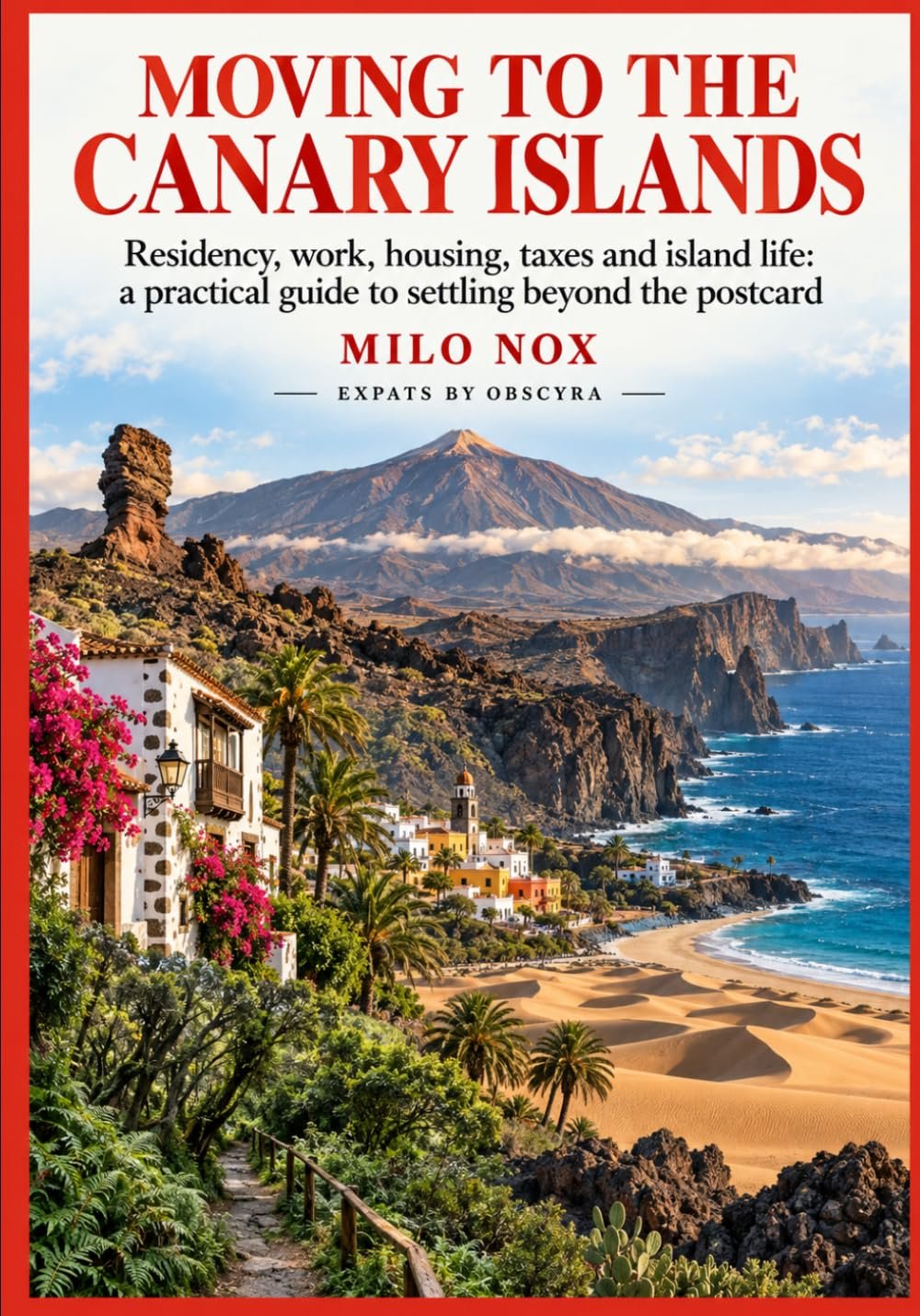
MOVING TO THE CANARY ISLANDS
Eight Canary Islands, eight different realities: residency, housing, taxes, healthcare and island-by-island decisions for a life beyond the postcard.
Ce que tu vas comprendre
You will understand how to prepare a relocation to the Canary Islands within the Spanish and European legal framework. The guide explains the differences between EU free movement, residence registration and immigration routes for non-EU nationals. It clarifies the respective roles of the NIE, TIE, EU registration certificate and padrón, and shows why a property purchase or a tourist stay does not automatically establish a right to live or work in Spain.
You will learn how to choose between the eight inhabited islands. Tenerife and Gran Canaria offer larger employment markets, more extensive transport networks and greater access to specialist healthcare. Smaller islands can offer a quieter environment but may require more careful planning around ferries, flights, medical referrals and everyday services. The guide helps you compare each island according to your income, family situation, mobility, health requirements and professional needs rather than relying on scenery alone.
You will discover the practical realities of finding accommodation. Long-term housing can be difficult to secure in tourist areas, and the difference between a legitimate temporary rental and an unsuitable contract matters. The book covers rental deposits, property verification, housing conditions, neighbourhood selection, damp, accessibility, utilities and the risks of paying before documentation has been checked.
You will understand the employment and financial environment. The guide examines local salaries, seasonal work, permanent and fixed-discontinuous contracts, freelance activity, remote employment, entrepreneurship and professional qualification recognition. It also addresses Spanish income taxation, tax residence, IGIC, the Canary special fiscal regime and the distinction between genuine incentives and oversimplified tax-saving claims.
You will learn how healthcare, schools and family services operate in practice. Eligibility for medical coverage is not the same as registration with a healthcare provider, and access to specialist treatment depends partly on your island. The book examines public and private healthcare, S1 arrangements, insurance, schooling, family law, children’s activities and accessibility. It also explains how to prepare for relocating with pets and arranging their veterinary care.
You will gain insight into Canarian life beyond the tourist economy. Spanish language skills, local routines, cultural identity, island traditions, neighbourhood relationships and community participation all contribute to integration. The guide addresses local concerns about tourism, housing, water resources, employment and migration without reducing residents to stereotypes.
Finally, you will learn to build a relocation plan that can withstand ordinary complications. Delayed appointments, housing shortages, unexpected medical travel, bad weather, transport disruption and administrative deadlines become easier to manage when you have documentation, financial reserves and realistic alternatives.
The 16 appendices turn this knowledge into practical tools: decision trees, budgets, comparison matrices, property checklists, administrative calendars, healthcare flows, school trackers, emergency information and a Spanish administrative vocabulary glossary.
Ce que ce guide ne promet pas
This guide does not promise that living in the Canary Islands is the same as enjoying a permanent holiday. Attractive weather and beautiful landscapes cannot remove housing shortages, administrative obligations, commuting difficulties or financial pressure.
It does not guarantee residency, employment or the right to work. Immigration routes depend on nationality, personal circumstances and current Spanish legislation. Having a NIE does not automatically establish residence rights, and buying property is not an independent immigration programme.
The book does not promise inexpensive housing or a uniformly low cost of living. Rent varies significantly between islands, municipalities and neighbourhoods. Tourist demand, property condition, transport requirements and household needs can change the financial picture considerably.
It does not claim that Canary tax incentives are available to everyone. IGIC, Spanish income taxation, tax residence, ZEC and other fiscal mechanisms have different purposes and conditions. Remote workers, retirees, employees and entrepreneurs must each examine the rules relevant to their circumstances.
It does not suggest that every island offers equivalent healthcare, schools, employment or transport. Specialist medical services are more concentrated on Tenerife and Gran Canaria, while smaller islands may require inter-island travel for certain appointments or procedures.
Nor does it promise automatic cultural integration. Speaking English, living in an international neighbourhood or participating in a few tourist activities does not replace learning Spanish, understanding local concerns and building relationships through everyday participation.
Finally, this guide is not a substitute for individual immigration, legal, tax, insurance, medical or financial advice. The research baseline is 21 September 2026. Figures, fees, fiscal thresholds and other time-sensitive rules must be checked against current official sources before making binding decisions.
The goal is not to persuade you to move. It is to help you determine whether the Canary Islands can support the life you actually want to build.
Sommaire détaillé
CONTENTS
CHAPTER 1 – INTRODUCTION (p. 1)
1.1 Why choose the Canary Islands? — p. 2
1.2 What to expect in practice — p. 4
1.3 Quick cultural overview — p. 5
1.4 Political environment & freedoms — p. 7
1.5 Social fractures & tensions — p. 9
CHAPTER 2 – PREPARING YOUR DEPARTURE (p. 11)
2.1 Required documents by profile — p. 12
2.2 Visas and residence routes – types, conditions, mistakes to avoid — p. 14
2.3 Health insurance – entry requirements — p. 17
2.4 Translations and equivalency — p. 18
2.5 Departure budget — p. 20
2.6 Pre-departure checklist — p. 21
2.7 Cancelling contracts in your home country — p. 22
2.8 Transport & international relocation — p. 24
CHAPTER 3 – SETTING UP LOCALLY (p. 27)
3.1 Finding housing — p. 28
3.2 Deposit & rental law — p. 30
3.3 Choosing a neighborhood — p. 32
3.4 Opening a bank account — p. 34
3.5 Tax ID, padrón and residence documents — p. 35
3.6 Setting up utilities (water, electricity, internet, gas) — p. 37
3.7 Furnishing your home — p. 38
3.8 Legal translations & support — p. 39
3.9 Local infrastructure quality — p. 41
3.10 Grey zones & informal workarounds — p. 42
3.11 Buying property & mortgage system — p. 44
3.12 Vehicle import & registration — p. 45
CHAPTER 4 – WORKING IN THE CANARY ISLANDS (p. 49)
4.1 Overview of the job market — p. 50
4.2 Finding a job locally — p. 52
4.3 Salary ranges & cost of life — p. 53
4.4 Freelance & entrepreneurship — p. 55
4.5 Work culture & hierarchy — p. 57
4.6 Discrimination & work rights — p. 59
4.7 Getting paid & tax obligations — p. 60
4.8 Maternity, sick leave & benefits — p. 62
4.9 Remote work & hybrid systems — p. 63
4.10 Recognition of foreign qualifications — p. 65
CHAPTER 5 – STUDYING IN THE CANARY ISLANDS (p. 69)
5.1 School system — p. 70
5.2 Higher education — p. 72
5.3 Learning Spanish and Canarian speech — p. 74
5.4 Integrating expat children — p. 75
5.5 Alternatives & homeschooling — p. 77
CHAPTER 6 – HEALTHCARE SYSTEM (p. 79)
6.1 General structure — p. 80
6.2 Registration & entitlements — p. 81
6.3 GPs and specialists — p. 83
6.4 Hospitals and emergency care — p. 84
6.5 Pharmacies & medication — p. 86
6.6 Private or supplementary insurance — p. 87
6.7 Rural and small-island healthcare access — p. 89
6.8 Sexual & reproductive health — p. 90
CHAPTER 7 – DAILY LIFE & INTEGRATION (p. 93)
7.1 Daily rhythm & public holidays — p. 94
7.2 Food & shopping — p. 95
7.3 Transport & driving — p. 96
7.4 Social interaction — p. 98
7.5 Breaking the expat bubble — p. 99
7.6 Religion & religious diversity — p. 100
7.7 Local etiquette — p. 101
7.8 Regional lifestyles — p. 102
7.9 Environmental norms — p. 103
7.10 Time, money & authority — p. 105
7.11 Everyday bureaucracy — p. 106
7.12 Everyday discrimination — p. 107
7.13 Disability & difference — p. 108
7.14 Informal survival strategies (“Plan B culture”) — p. 109
CHAPTER 8 – MONEY, TAXES & COST OF LIVING (p. 111)
8.1 Tax residency & treaties — p. 112
8.2 Income tax, IGIC and other taxes — p. 113
8.3 Banking, transfers & payments — p. 114
8.4 Legal tax planning and Canary incentives — p. 116
8.5 Real cost of living — p. 117
8.6 Inheritance & succession — p. 119
CHAPTER 9 – FAMILY & CHILDREN (p. 121)
9.1 Social benefits — p. 122
9.2 Early childhood & parenting culture — p. 123
9.3 Children’s activities & public spaces — p. 125
9.4 Family law — p. 126
9.5 LGBTQ+ families — p. 128
9.6 Mixed couples & intercultural relationships — p. 129
9.7 Local adoption — p. 130
CHAPTER 10 – PETS & ANIMAL COMPANIONS (p. 133)
10.1 Entry into Spain/Canary Islands — p. 134
10.2 Transport — p. 135
10.3 Rentals with pets — p. 136
10.4 Veterinary care — p. 137
10.5 Cultural perception — p. 139
10.6 Access to public spaces — p. 140
10.7 Climate & acclimatization — p. 141
10.8 Local adoption — p. 142
CHAPTER 11 – SAFETY & SECURITY (p. 145)
11.1 Crime & perception — p. 146
11.2 Natural risks — p. 147
11.3 Emergencies & responsiveness — p. 148
11.4 Police & security services — p. 150
11.5 Everyday corruption and fraud — p. 151
11.6 Political unrest and demonstrations — p. 152
11.7 Digital discretion & personal protection — p. 153
11.8 Mapping social fault lines — p. 154
11.9 Justice & legal disputes — p. 155
11.10 Activism, protest & associated risks — p. 156
CHAPTER 12 – HIDDEN CHALLENGES (p. 159)
12.1 Loneliness & integration — p. 160
12.2 Environmental stress — p. 161
12.3 Cultural burnout — p. 162
12.4 Hidden language codes — p. 163
12.5 Mutual aid networks — p. 164
12.6 Dealing with uncertainty — p. 165
12.7 Reverse culture shock — p. 166
12.8 Leaving the Canary Islands/Spain — p. 167
CHAPTER 13 – WHAT NOT TO DO: TRAPS, MISTAKES & ILLUSIONS (p. 169)
13.1 Cultural and legal no-gos — p. 170
13.2 Behaviors that come off as arrogant or offensive — p. 172
13.3 Language mistakes to avoid — p. 173
13.4 The expat illusions you should dismantle — p. 174
13.5 Mental deprogramming & unconscious bias — p. 176
13.6 The reality check test — p. 177
CHAPTER 14 – OFF-THE-RADAR PLACES, TRADITIONS & EXPERIENCES (p. 179)
14.1 Hidden or overlooked nature — p. 180
14.2 Rural, minority & traditional communities — p. 181
14.3 Unique accommodations — p. 182
14.4 Living rituals & traditions — p. 183
14.5 A hidden gem per island — p. 185
CHAPTER 15 – ESSENTIAL TOOLS & LOCAL RESOURCES (p. 189)
15.1 Must-have apps and digital tools — p. 190
15.2 Official portals — p. 194
15.3 Forums & online communities — p. 198
15.4 Places to socialize in real life — p. 200
15.5 Local media — p. 202
15.6 Alternative channels and data sources — p. 204
CHAPTER 16 – FINAL THOUGHTS & SMART CHECKLIST (p. 209)
16.1 Strengths & weaknesses of the Canary Islands — p. 210
16.2 Who thrives and who struggles — p. 213
16.3 Keys to making it work — p. 215
16.4 What you can do now — p. 217
APPENDICES (p. 221)
Appendix A1 – Residency route decision tree — p. 222
EU/EEA/Swiss citizens; EU family members; digital nomads; employees; self-employed workers; students; non-lucrative residents; family members of Spanish citizens; family reunification.
Appendix A2 – NIE vs TIE vs EU certificate vs padrón: one-page explainer — p. 222
Appendix A3 – Document legalization matrix — p. 223
EU public documents, Hague apostille countries and non-Hague legalization.
Appendix A4 – 90/60/30/7-day relocation checklist — p. 224
Appendix A5 – Arrival-week checklist by island — p. 224
Appendix A6 – Six monthly budget templates and editable cost worksheet — p. 227
Appendix A7 – Island comparison matrix — p. 230
Tenerife, Gran Canaria, Lanzarote, Fuerteventura, La Palma, La Gomera, El Hierro and La Graciosa.
Appendix A8 – Long-term rental viewing checklist — p. 234
Legal status, building condition, damp, noise, accessibility, utilities, internet, wildfire and flood exposure.
Appendix A9 – Property purchase due-diligence checklist — p. 236
Appendix A10 – Autónomo first-90-days tax/Social Security calendar — p. 237
Appendix A11 – Healthcare registration flowcharts — p. 239
Workers, pensioners/S1, dependants and privately insured newcomers.
Appendix A12 – School admissions documents and annual calendar tracker — p. 240
Appendix A13 – Pet-entry checklist by origin category — p. 241
Appendix A14 – Emergency card — p. 243
Emergency number 112, consulate, insurer, medication, emergency contacts and pet contacts.
Appendix A15 – Spanish admin vocabulary glossary (150–250 terms) — p. 244
Appendix A16 – Official portals directory — p. 249
SOURCES & BIBLIOGRAPHY (p. 253)
GO FURTHER (p. 257)
Guides proches
Lire le chapitre 1
Tu peux consulter le premier chapitre avant d’acheter le guide.